Pipelines & Plastics
Butt Fusion vs Electrofusion: PE Pipe Joints Compared
In brief Butt fusion joins PE pipe by heating both pipe ends against a plate and pressing them together — best for long straight runs of the same size and SDR. Electrofusion uses fittings with embedded heating coils — best for repairs, connections and restricted spaces. Both produce joints stronger than the pipe when done correctly; both fail on contamination, misalignment or wrong parameters, which is why certified welders and independent joint testing are specified on water networks.
Ireland’s water infrastructure is, joint by joint, becoming a polyethylene network. PE pipe itself is superbly reliable — flexible, corrosion-immune, 50-year-plus design life. Its vulnerability is concentrated in one place: the fusion joint made in a trench, in Irish weather, by a human being under time pressure. Understanding the two jointing methods — and how joints are proven — is the difference between a network and a liability.
The two methods, plainly
Butt fusion: heat, then press
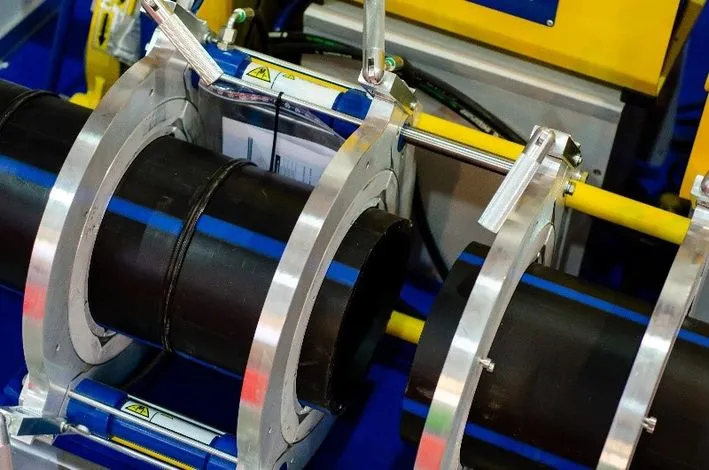
Butt fusion clamps two pipe ends in a machine, trims them plane with a facing tool, heats both faces against a heater plate, then presses them together under controlled pressure to cool. Done right, the result is a homogeneous joint with the characteristic double bead — effectively one continuous pipe.
Its natural territory: long runs of the same diameter and SDR, welded above ground on rollers and fed into the trench. The machine does the heavy lifting, but procedure discipline — facing, heater temperature, soak, pressure, cooling time — decides the joint.
Electrofusion: the fitting does the heating
Electrofusion uses couplers, saddles and tapping tees with heating coils moulded into the bore. Prepared pipe ends are inserted, the control box drives the fusion cycle from the fitting’s barcode, and the melt zone fuses fitting to pipe.
Its natural territory: connections, repairs, tie-ins and tight spaces — anywhere a butt fusion rig cannot practically go, and any joint between components a heater plate cannot handle. The equipment is lighter; the sensitivity moves to preparation.
Where each belongs
| Situation | First choice | Why |
|---|---|---|
| Long mains runs, open trench | Butt fusion | Fast per joint at scale; one machine setup |
| Repairs under live conditions | Electrofusion | No need to align a rig; fittings tolerate site reality |
| Connections, branches, tappings | Electrofusion | Purpose-made fittings |
| Different SDR / wall thickness | Electrofusion | Butt fusion needs matched ends |
| Restricted chambers and pits | Electrofusion | Compact equipment |
| Large diameters, plant welding | Butt fusion | Controlled conditions, recorded parameters |
Most schemes use both — which means crews need certification, and quality assurance needs to cover both failure modes.
Why joints fail (and it is rarely the pipe)
Butt fusion failures trace to: contaminated or oxidised faces (facing skipped or touched afterwards), wrong heater temperature or soak, insufficient or excessive fusion pressure, premature removal from clamps, and cold-weather shortcuts on cooling time. Machine condition — heater plate surface, pressure gauge calibration — sits underneath all of it.
Electrofusion failures trace to: the oxide layer left on (pipe not scraped or under-scraped), contamination after scraping (hands, rain, trench mud), pipe not fully inserted or clamped, movement during the cooling cycle, and mismatched or damp fittings. The melt cannot fuse what it cannot reach — preparation is the joint.
The pattern across both: operative-controlled variables dominate. Equipment matters, procedure matters, but the person and their discipline matter most.
Proving quality: certification + testing
Utilities and their engineers close the loop on fusion quality from two ends, and Metlab works at both:
Before the joint — certified welders. Plastics welders are examined and certified under I.S. EN 13067 — technique- and material-specific examination with test assemblies assessed against acceptance criteria. Certificates run for two years, prolonged on documented evidence of continuous, satisfactory work. Metlab certifies plastics welders under its INAB-accredited ISO/IEC 17024 scope, and in 2020 partnered with Impact Training — at the initiative of the Waterford & Wexford ETB — to develop the first certified PE electrofusion welding course in Ireland.
After the joint — independent testing. Sample joints tell the truth about a crew:
- Electrofusion: decohesion (peel) testing of sectioned fittings — the fusion interface is progressively separated and judged on ductility and brittle-failure percentage.
- Butt fusion: bead inspection (external and internal) plus destructive testing of joint specimens.
- Regimes: sample joints per crew and per machine at mobilisation, at intervals through the contract, and immediately on suspicion.
Testing at mobilisation deserves emphasis: proving each crew’s joints before they disappear under a road is the cheapest quality decision on the whole scheme.
A specification that actually protects the network
For a PE scheme of any consequence, the QA clauses worth writing:
- All fusion operatives certified to I.S. EN 13067 for the technique and material in use — certificates current, not expired.
- Machine records: calibration and service history for rigs and control boxes; joint records downloaded and retained.
- Sample joint testing by an independent laboratory at mobilisation and at a defined frequency, with acceptance criteria named.
- Failed sample → crew stood down for re-verification; affected joints reviewed.
Four clauses, and the buried asset stops depending on hope.
Metlab tests butt and electrofusion PE joints at our laboratories, audits fusion crews on site, and certifies plastics welders — one accountable partner from competence to verification.
Frequently asked questions
Which is stronger, butt fusion or electrofusion?
Correctly made, both produce fully end-load-resistant joints that outlast the pipe. The practical difference is failure tolerance: butt fusion quality depends on machine condition and procedure; electrofusion adds sensitivity to scraping, cleanliness and clamping. Joint choice should follow the situation — strength comes from doing the chosen method properly.
Why do electrofusion joints fail?
Overwhelmingly through preparation: unscraped or under-scraped pipe (oxide layer left on), contamination from hands, mud or moisture after scraping, poor alignment or unclamped movement during cooling, and incorrect fusion parameters. The uncomfortable truth is that most electrofusion failures are avoidable operative errors — the case for certified welders and joint audits.
How are PE pipe joints tested?
Electrofusion joints are typically assessed by decohesion (peel) testing of sectioned fittings, examining the fusion interface for ductility and the proportion of brittle failure. Butt fusion joints are assessed by bead inspection plus tensile-type destructive tests of joint specimens. Metlab tests sample joints in the laboratory and reports against the applicable specification.