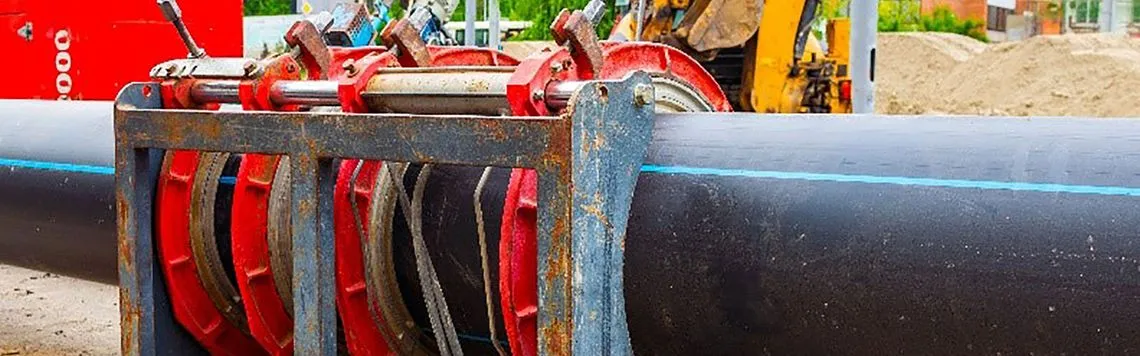
Polyethylene pipe testing verifies the integrity of butt fusion and electrofusion joints in PE pipe assemblies — the joints that water and gas networks depend on for their design life. Metlab tests PE pipe joints in the laboratory and audits fusion quality on site across Ireland.
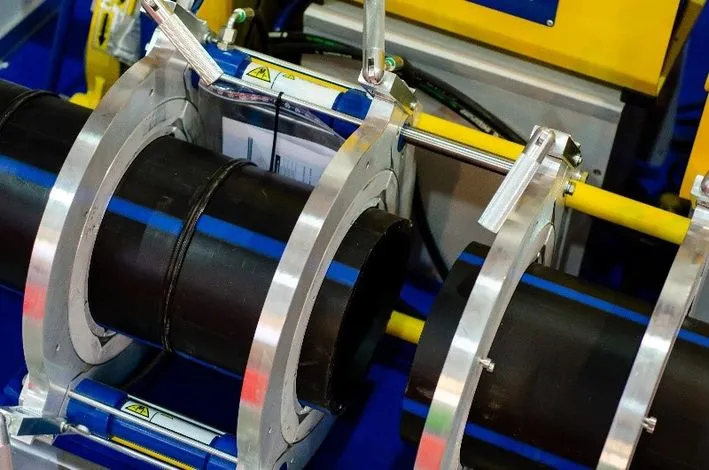
Polyethylene pipe joint made on a butt fusion rig
Overview
PE pipe itself rarely fails; joints do. Fusion quality depends on operator technique, machine condition, weather and preparation — and the only way to know a crew’s joints are sound is to test them. Metlab provides independent testing of butt and electrofusion polyethylene pipe assemblies for utilities, contractors and manufacturers.
Testing is carried out at our laboratories with results issued under Metlab’s quality system, giving asset owners objective evidence of jointing quality before pipelines are buried, charged and handed over.
Joint testing
Butt fusion joint testing
Tensile and bend assessment of fusion joints against specification
Electrofusion joint testing
Decohesion / peel testing of couplers and saddle fittings
Weld bead assessment
Visual and dimensional examination of external and internal beads
Failure investigation
Determining why a joint or pipeline section failed
Site quality assurance
Fusion crew audits
On-site verification of jointing practice, machine records and traceability
Pre-contract crew verification
Sample joints tested before crews start on a network contract
Welder certification
Operative certification to I.S. EN 13067 via our certification body
Standards & schemes
Work is examined against the designations your specification cites.
| Standard | What it covers |
|---|---|
| EN 12201 | PE piping systems for water supply and drainage under pressure |
| I.S. EN 13067 | Certification of the operatives making the joints |
| WIS 4-32-08 | UK water industry specification for PE pipe systems — reference for fusion jointing quality |
Why it matters
01
Leakage targets start at the joint
National leakage-reduction programmes are only as good as the thousands of fusion joints made each year. Independent joint testing catches systematic jointing problems before they become buried liabilities.
02
Evidence for adoption and handover
Test certificates for sample joints give utilities and their engineers objective grounds to adopt new mains — and give contractors proof their work met specification.
03
Ireland’s established PE specialists
From the first certified electrofusion course in Ireland to routine joint audits, PE jointing quality has been a Metlab specialism for decades.
Common questions
Asked before every engagement.
Something more specific? A specialist will answer it directly.
Ask usHow are electrofusion joints tested?
The standard laboratory method is a decohesion (peel) test: the fitting is sectioned and the fusion interface is progressively separated to assess ductility and the proportion of brittle failure against acceptance criteria. Visual and dimensional checks accompany the mechanical test.
How many sample joints should a project test?
Specifications vary, but a common approach is testing sample joints per crew, per machine, at mobilisation and then at intervals or on suspicion. We advise on sampling regimes appropriate to the contract specification and risk.
Can you test joints from a live failure investigation?
Yes — failed sections can be examined to determine whether the cause was fusion procedure, contamination, misalignment, pipe quality or third-party damage, with a written engineering report.
Testing · Inspection · Certification
Need pe pipe testing?
Send the specification or describe the asset — a specialist replies with method, price and turnaround.