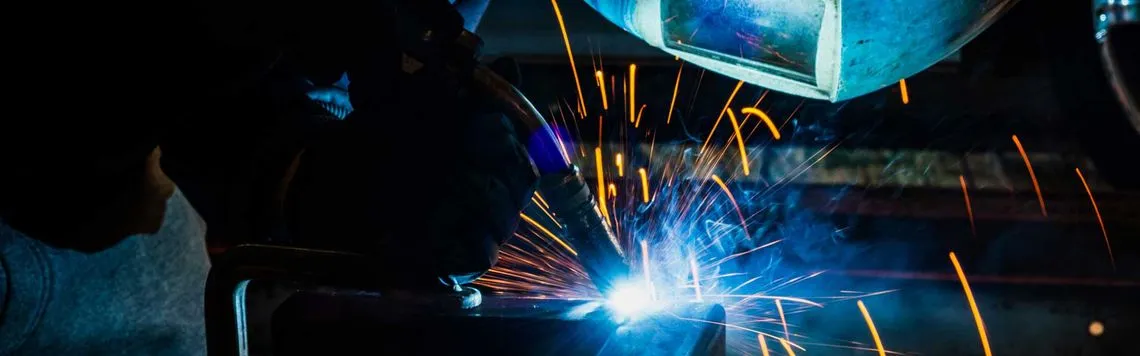
Prove every weld, and the welder behind it
Welder Qualification & Weld Procedure Certification
Welder qualification (WQT) proves a person can produce a sound weld to a defined standard; a weld procedure qualification (WPQR) demonstrates the welding process is inherently sound. Metlab certifies both — welder tests (WQT) as an INAB-accredited certification body (ISO/IEC 17024, Reg. 7007) and weld procedures (WPQR) as an INAB-accredited inspection body (ISO/IEC 17020, Reg. 9031). Metlab is also a State-appointed Recognised Third-Party Organisation (RTPO) under the Pressure Equipment Directive (PED).
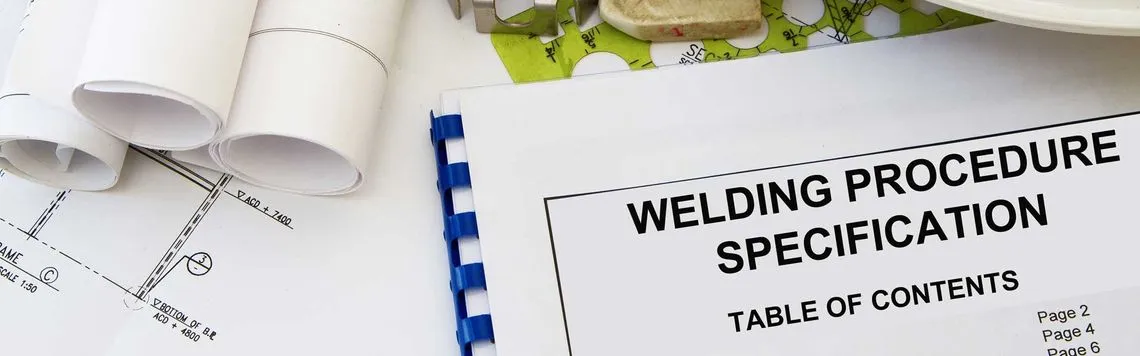
Welding procedure specification reviewed before qualification
Overview
On any coded fabrication job, two questions decide whether the welding stands up to scrutiny: is the procedure qualified, and is the welder certified to it? Metlab answers both with independent, third-party certification that fabricators, notified bodies and clients accept without argument.
We examine welders against the scheme your contract demands, witness the test pieces, arrange mechanical testing and NDT of coupons at an approved laboratory, and issue certification with full traceability. An impartiality committee safeguards the independence of every certification decision — we are not a manufacturer, designer, supplier or installer.
Certification services
Welder qualification testing
Steel and aluminium — EN ISO 9606-1, 9606-2 and ASME IX
Welding operator certification
Mechanised and automatic welding — EN ISO 14732 and ASME IX
Weld procedure specification (WPS)
Drafting and review of procedure specifications
Weld procedure qualification (WPQR)
ISO 15614 series and ASME IX qualification records
Certificate prolongation
Revalidation of welder certificates before expiry
Weld X-ray & coupon testing
Radiographic and destructive examination of test pieces
For pressure equipment & structural steel
RTPO services under PED 2014/68/EU
Approval of permanent joining procedures and personnel for pressure equipment
CE-marking support for fabricators
Welding certification supporting EN 1090 structural steel conformity
Third-party welding inspection
CSWIP-qualified inspection during production
Standards & schemes
Work is examined against the designations your specification cites.
| Standard | What it covers |
|---|---|
| EN ISO 9606-1 / 9606-2 | Qualification testing of welders — steels / aluminium |
| ISO 15614-1 / -2 / -6 / -8 | Welding procedure qualification — arc welding of steels, aluminium, copper, pipe-to-plate |
| ASME IX | Welder and procedure qualification for ASME code work |
| BS 4872-1 / -2 | Welder approval where procedure approval is not required |
| EN ISO 14732 | Welding operators — mechanised and automatic welding |
| PED 2014/68/EU | RTPO approval of permanent joining (procedures and personnel) |
Why it matters
01
Contracts demand third-party proof
Main contractors, notified bodies and utilities increasingly require welder certificates issued by an accredited certification body — not in-house paperwork. ISO/IEC 17024 accreditation is exactly that assurance.
02
Pressure equipment has no grey area
Under the Pressure Equipment Directive, permanent joining on category II–IV equipment must be approved by a competent third party. As a State-appointed RTPO, Metlab provides that approval in Ireland.
03
Certificates that travel
Qualifications to EN ISO 9606-1 are recognised across the EU and referenced by EN 1090 and ISO 3834 — one test, accepted on the next contract too.
Common questions
Asked before every engagement.
Something more specific? A specialist will answer it directly.
Ask usWhat is the difference between a WPS, a WPQR and a welder certificate?
A WPS (welding procedure specification) is the recipe — process, materials, parameters. A WPQR (welding procedure qualification record) is the evidence that recipe produces sound welds, established by testing. A welder certificate proves an individual can execute a qualified procedure. Coded work generally requires all three.
How long does a welder qualification to EN ISO 9606-1 last?
The certificate must be confirmed every six months by the person responsible for welding, and then revalidated by one of three routes in clause 9.3: re-testing every three years; two-yearly revalidation on the evidence of two production welds tested within the previous six months; or continued validity under a verified ISO 3834-2/-3 quality system. Metlab manages confirmation and prolongation so certification never lapses mid-contract.
Are there prerequisites for taking a welder qualification test?
No formal prerequisites — the candidate must simply be physically capable of welding the joint in question. The test piece is welded under examination conditions, indelibly marked, and then tested at an approved laboratory by destructive or non-destructive methods depending on the scheme.
Can a certificate be withdrawn?
Yes. Where there is a specific reason to question a welder’s ability to meet product quality requirements, the certificate is suspended or withdrawn in line with EN ISO 9606 and ASME IX rules — that independence is what gives third-party certification its value.
Public information · EN ISO/IEC 17020 & 17024
Statements on certification
Metlab provides details of its certification activities without request — independence and impartiality safeguards, the certification process, the schemes we certify to, and downloadable accreditation certificates, scopes and procedures.
Testing · Inspection · Certification
Need welding certification?
Send the specification or describe the asset — a specialist replies with method, price and turnaround.