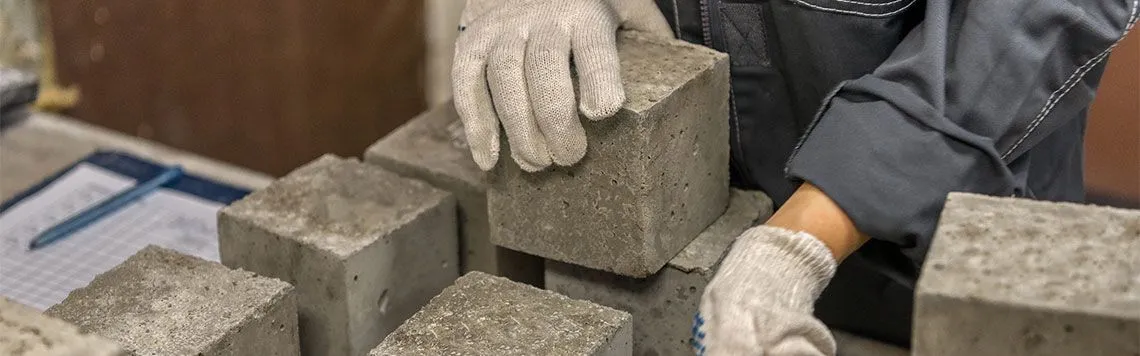
Concrete testing verifies that placed concrete achieves its specified strength and properties — from slump and sampling at the pour to compressive testing of cubes and cores in the laboratory. Metlab tests concrete across the full project lifecycle from its Cork and Dublin laboratories.
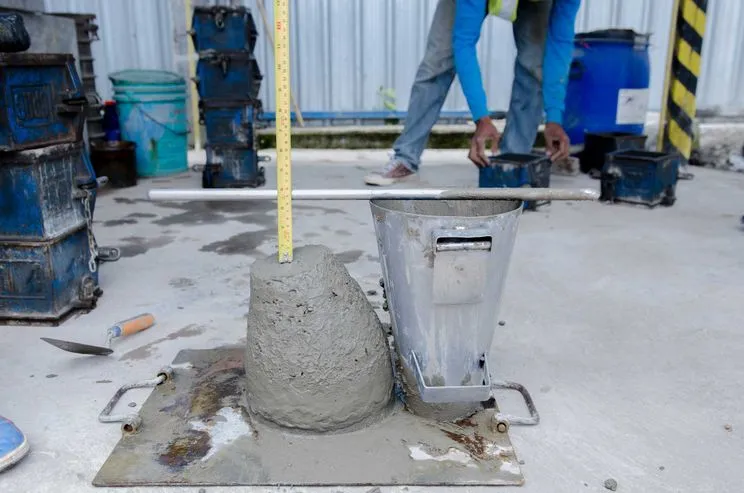
Concrete slump test carried out at the point of pour
Overview
Concrete is accepted on evidence: sampled at the pour, cured, crushed and certified. When cubes pass, the record protects everyone; when they fail, early warning is the difference between investigating one pour and coring a finished structure.
Metlab provides site sampling and slump testing, laboratory compression testing of cubes and cores, and the supporting tests — density, water absorption, flexural strength — that specifications call up. Results are certified promptly so construction never waits on paperwork.
Fresh concrete — on site
Sampling of fresh concrete
Representative sampling at the point of placement
Slump testing
Consistence verification against the specified class
Cube manufacture & curing
Moulding, marking and curing regimes to standard
Temperature & air content
Fresh properties affecting long-term performance
Hardened concrete — laboratory
Compressive strength — cubes
7-day and 28-day compression testing
Compressive strength — cores
Assessment of in-situ strength in existing structures
Flexural testing
Beam testing for pavement-quality concrete
Mass per unit volume
Hardened density determination
Water absorption
Durability indicator testing
Standards & schemes
Work is examined against the designations your specification cites.
| Standard | What it covers |
|---|---|
| I.S. EN 12390 series | Testing hardened concrete — cube and core compressive strength, density, flexure |
| I.S. EN 12350 series | Testing fresh concrete — sampling, slump, air content |
| I.S. EN 206 + Irish NA | Concrete specification, performance and conformity context |
| I.S. EN 12504-1 | Cores — cutting, examination and testing in compression |
Why it matters
01
Acceptance criteria are strength-based
Structures are signed off against strength-based acceptance criteria. Cube results are the contractual evidence — and core tests answer whether an existing structure has the capacity a reuse or extension assumes.
02
Early detection changes outcomes
A 7-day result trending low is a manageable conversation with the ready-mix supplier. A failed 28-day result discovered late, with three floors poured above, is not.
03
Chain of custody, done properly
Sampling, curing and testing all influence the number on the certificate. One provider controlling the chain removes the classic failure excuses — poor curing, late testing, mislabelled cubes.
Common questions
Asked before every engagement.
Something more specific? A specialist will answer it directly.
Ask usWhy test at both 7 and 28 days?
Specified strength is defined at 28 days, but 7-day results — typically a substantial fraction of final strength for CEM I concretes — give early warning of a problem batch while corrective options are still cheap. Trending both is standard good practice.
What causes concrete cubes to fail?
Common causes include water added on site, poor sampling or compaction of the cube, inadequate curing, and batching errors. Because failure triggers investigation of the structure, correct cube-making and curing matter as much as the mix — our technicians control both.
Can you test concrete in an existing structure?
Yes — cores are cut, examined and tested in compression to assess in-situ strength for structural assessments, change-of-use checks and investigations of non-conforming cube results.
How quickly do we get results?
Cube results are certified on the day of test (the 7- or 28-day date), with failed results flagged to the responsible engineer immediately.
Testing · Inspection · Certification
Need concrete testing?
Send the specification or describe the asset — a specialist replies with method, price and turnaround.