Concrete & Materials
Concrete Cube Testing: Why Cubes Fail & How to Avoid It
In brief Concrete cube testing verifies that placed concrete achieves its specified compressive strength: cubes are sampled at the pour, cured under controlled conditions and crushed — typically at 7 and 28 days — under the I.S. EN 12390 series. Most "failures" trace to sampling, compaction or curing errors rather than bad concrete, which is why controlled sampling and curing matter as much as the crush itself.
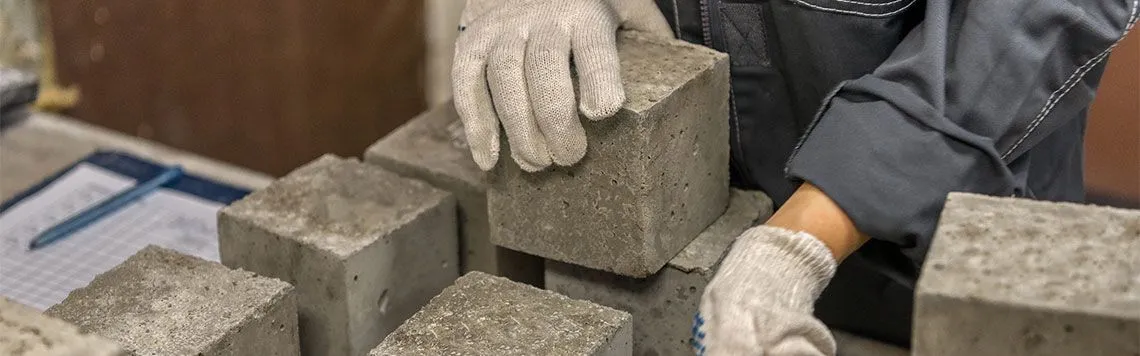
No result in construction triggers arguments faster than a failed concrete cube. The pour is buried, the frame is climbing, and a single number now questions all of it. Yet in our laboratories’ experience, a large share of “failed” cubes are not failed concrete at all — they are failed process: sampling, compaction or curing done badly. This guide covers how cube testing is supposed to work, and how to keep bad process from manufacturing bad news.
What cube testing proves
Concrete is specified by characteristic compressive strength — the C25/30, C32/40 designations of I.S. EN 206 — and accepted on evidence from standard test specimens. In Ireland and the UK the specimen is the cube (150 mm or 100 mm), tested in compression under I.S. EN 12390-3, with specimen requirements and curing governed by the companion parts of the EN 12390 and EN 12350 series.
The result answers one question with contractual force: did this batch achieve its specified strength class?
The chain that decides the number
The crush is the easy part. The number on the certificate is manufactured by everything before it:
- Sampling (EN 12350-1). Taken at the point of placement, representative of the batch — not the first barrow out of the truck.
- Making the cube. Filled in layers, each layer properly compacted; moulds clean, true and lightly oiled; surface finished; cube marked indelibly.
- Initial curing. Protected on site at controlled temperature, undisturbed — the first 24 hours are where site cubes are most often ruined (frozen in winter, cooked in a cabin in summer, vibrated on a genny bench).
- Laboratory curing. Demoulded and cured in water at controlled temperature until test age.
- Testing. Weighed and measured (density is the free health-check most people ignore), then crushed in a calibrated machine at a controlled loading rate; failure pattern recorded.
Break any link and the number stops representing the concrete. This is the practical argument for one accountable provider across sampling, curing and testing: when Metlab controls the chain, a low result means the concrete — not the process — needs the conversation.
7-day vs 28-day: using the early warning properly
The 28-day result is the specification; the 7-day result is intelligence. For typical CEM I-based mixes the 7-day strength lands at a broadly predictable fraction of the eventual 28-day value, so a trending log of 7-day results does two jobs:
- Flags a rogue batch while the supplier conversation is easy and the affected pour is identifiable.
- Establishes each mix’s normal ratio, so an odd 28-day result can be sanity-checked against its own 7-day partner.
Blended cements gain strength more slowly — their 7:28 ratio is lower — which is exactly why the trend for your mix beats any rule of thumb.
Why cubes really fail
In rough order of what we actually see:
| Cause | Mechanism | Tell-tale |
|---|---|---|
| Water added on site | Raised w/c ratio cuts strength | Whole set low; slump records high |
| Poor cube compaction | Entrapped voids in the specimen | Low density; honeycombed faces |
| Bad initial curing | Frost or heat in first 24 h | Site-cured set low, lab checks fine |
| Sampling error | Non-representative sample | One sample low, adjacent pours fine |
| Batching error | Wrong mix delivered | Density and appearance off; supplier records |
| Genuine low-strength concrete | The rare real one | Consistent across cubes and density normal |
The density check deserves a special mention: a cube significantly below the expected density almost always announces a specimen problem before the crush does.
When a 28-day result fails anyway
Keep the response systematic, not political:
- Audit the paperwork — sampling records, curing logs, cube density, machine calibration.
- Review the companion results — the 7-day partner and adjacent samples.
- Assess the structure — what element, what stress level, what does the designer actually need?
- Core if necessary — cores cut, examined and compression-tested to I.S. EN 12504-1 establish the in-situ strength that acceptance decisions can stand on.
A failed cube is a question, not a verdict. Cores answer it.
Getting it right from the first pour
- Book testing before the pour schedule, not after — sampling coverage should follow the specification, and it cannot be retrofitted.
- Give cubes a decent home on site: a curing tank or insulated box, away from plant vibration.
- Insist on density being reported with every strength result.
- Keep 7-day trends per mix design, and share them with the ready-mix supplier — the best failure is the one headed off a week early.
Metlab tests concrete across the full lifecycle — sampling and slump on site, cubes and cores in our Cork and Dublin laboratories, results certified the day of test and failures flagged to the engineer immediately.
Frequently asked questions
Why are concrete cubes tested at 7 and 28 days?
Specified (characteristic) strength is defined at 28 days, so the 28-day result is the contractual one. The 7-day test exists for early warning: for typical mixes it reaches a substantial, reasonably predictable fraction of the 28-day strength, so a low 7-day result flags a problem batch while corrective action is still cheap.
What happens if a concrete cube fails at 28 days?
First the paperwork is checked — sampling, curing records, cube condition and density, and the testing machine records. If the result stands, the investigation moves to the structure: assessment of the affected pour, and where necessary core testing to I.S. EN 12504-1 to establish the in-situ strength before any decision on acceptance, remediation or removal.
How many cubes should be taken per pour?
The specification governs, but a common regime is one sample per defined volume or per day’s pour, with each sample yielding cubes for 7-day and 28-day testing plus a spare. What matters as much as the count is that sampling is representative and cubes are made and cured to standard — a badly made cube tests the cube-maker, not the concrete.