Corrosion & Integrity
Corrosion Under Insulation (CUI): Finding the Hidden Failure
In brief Corrosion under insulation (CUI) is external corrosion of pipework and vessels concealed beneath thermal insulation, driven by moisture trapped against the metal. It is dangerous precisely because it is invisible until insulation is removed or the component leaks. Managing it means risk-ranking insulated systems by temperature and moisture exposure, then targeting inspection — selective insulation removal and NDT screening — at the highest-risk locations first.
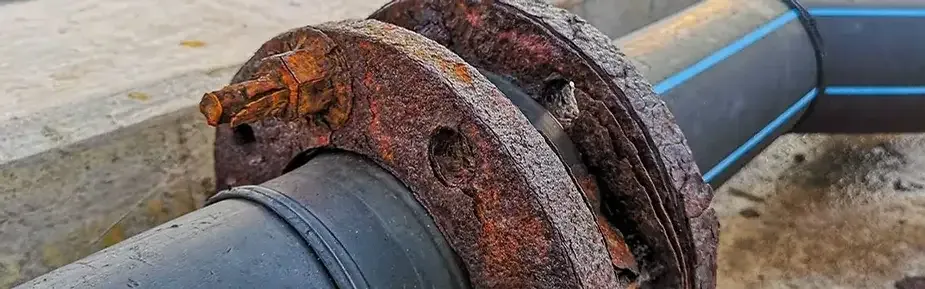
The most expensive corrosion on an industrial site is the corrosion nobody can see. Pipe and vessel surfaces under insulation can corrode for years behind intact-looking cladding — then announce themselves as a leak, a failed hydrotest, or worse. Corrosion under insulation has earned its reputation as the classic surprise failure of insulated plant, and managing it is a discipline, not a lucky find.
Why insulation creates a corrosion machine
Insulation does two unhelpful things at once: it lets water in — through damaged cladding, unsealed penetrations, failed mastic, gravity — and then holds it against warm steel. The result is a continuously wetted, oxygen- fed corrosion cell with none of the drying that exposed steelwork enjoys.
The risk concentrates where moisture persists and stays active:
- Temperature bands that keep water liquid and aggressive on carbon steel — including hot systems whose surfaces still spend time in the wet range, and especially cyclic and intermittent services that repeatedly pass through it.
- Water entry points: cladding damage, low points and horizontal runs, nozzles and supports, valve and instrument penetrations, dead-legs.
- Age: insulation systems degrade; a 25-year-old lagging job should be treated as permeable until proven otherwise.
Austenitic stainless steel adds its own failure mode under insulation — chloride-driven external stress corrosion cracking — which is nastier than wall loss because cracking gives less warning.
Why CUI defeats routine inspection
Ordinary external inspection sees cladding, not steel. Ordinary internal inspection sees the bore, not the outside surface. CUI lives precisely in the blind spot between them — which is why plants with respectable inspection programmes still get surprised, and why CUI needs to be attacked as its own programme rather than an afterthought.
A CUI programme that actually works
The structure our corrosion engineers apply:
- Inventory and risk-rank. List insulated systems; score each by operating temperature profile (including cycling), insulation type, age and condition, service criticality and visible cladding damage. The output is a prioritised target list, not a plant-wide strip.
- Survey the envelope. A systematic external survey of cladding condition — damage, open seams, failed sealant, staining, bulging — maps the likely water entry points and upgrades or downgrades the risk ranking with evidence.
- Open inspection windows. Selective insulation removal at the highest-risk locations. Windows are cheap; they convert speculation into data.
- Screen with NDT. At windows and suspect areas: visual assessment and ultrasonic thickness measurement to quantify wall loss; wider screening techniques as geometry and access allow. Findings are measured, not adjectival — millimetres and rates, not “some corrosion noted”.
- Disposition and record. Each location closes with a decision — repair, monitor, re-insulate with upgrades, or strip further — and enters a register that makes the next survey cheaper and smarter.
The output an asset owner should demand from any CUI survey: a quantified condition register, prioritised repairs, and a defensible basis for what was not inspected — because a CUI programme is a sampling argument, and the sampling logic is the deliverable.
The economics, briefly
CUI programmes are bought reluctantly because the spend is visible and the benefit is an absence. The comparison that settles it: an inspection window plus UT screening costs a technician-day; an undetected CUI failure on a live process line costs an unplanned outage, emergency repair, and — where the HSA takes an interest — considerably more. Insurers increasingly ask what the CUI strategy is; “we repaint what we can see” is not an answer that ages well.
Where Metlab fits
Corrosion assessment is one of Metlab’s founding disciplines. Our CUI work combines the corrosion survey — extent, severity, deterioration prediction — with the NDT to quantify it (UT thickness, corrosion mapping) and the laboratory to investigate what failed samples reveal, all under INAB-accredited systems. One programme, one register, one accountable provider — across pharmaceutical, energy, marine and process sites in Ireland since 1982.
Suspect your insulated systems are overdue an honest look? A risk-ranked CUI survey scoped to your plant costs less than you expect — ask us.
Frequently asked questions
What causes corrosion under insulation?
Water — from rain, washdown, condensation or leaks — penetrating insulation and being held against the steel surface. Damaged cladding, poor sealing, low points and penetrations let moisture in; the insulation then traps it, creating a persistent corrosion cell exactly where nobody can see it.
Which equipment is most at risk of CUI?
Insulated carbon steel operating in temperature ranges that keep trapped moisture liquid and active — including systems that cycle through them — plus any location where water ingress is likely: damaged or missing cladding, horizontal runs and low points, nozzles, supports, valves and dead-legs. Intermittently operating systems are notorious because surfaces repeatedly pass through wet conditions.
How is CUI detected without stripping all the insulation?
By combining risk-based targeting with screening: visual survey of cladding condition, selective insulation removal at high-risk locations (inspection windows), and NDT screening of suspect areas — ultrasonic thickness measurement at exposed windows and other appropriate techniques by access and geometry. Full stripping is reserved for what screening condemns.