Welding & Certification
WPS vs WPQR: Weld Procedure Qualification Explained
In brief A WPS (welding procedure specification) is the written recipe for making a weld; a WPQR (welding procedure qualification record) is the test evidence proving that recipe produces sound welds. Under ISO 15614-1 a procedure is qualified by welding a test piece, subjecting it to NDT and destructive tests, and recording the qualified ranges — production WPSs are then written within those ranges.
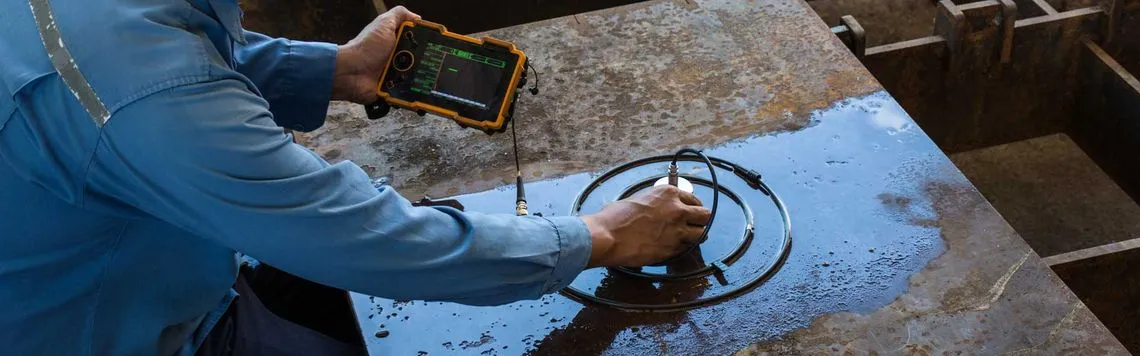
Ask three people on a site what “the weld procedure” means and you will get three answers: the laminated sheet by the welding set, the folder in the QA office, or the test certificate from years ago. All three are real documents with different jobs — and confusing them is how non-conformances start. Here is the clean version.
The three documents, in order
- pWPS — preliminary welding procedure specification. The engineer’s best first draft of the recipe: process, parent material, consumables, joint design, parameters, positions, heat input, preheat and interpass limits.
- WPQR — welding procedure qualification record. The evidence. A test piece is welded to the pWPS under witness, then examined and destructively tested. The WPQR records what was welded, how, the results, and the ranges the tests qualify.
- WPS — welding procedure specification. The production document, written within the WPQR’s qualified ranges, that welders actually follow. One WPQR commonly supports several WPSs.
The direction of authority matters: a WPS is only as valid as the WPQR behind it. Auditors check the chain — WPS → WPQR → laboratory test reports — and any break in it is a finding.
How qualification works under ISO 15614-1
ISO 15614-1 (arc and gas welding of steels and nickel alloys) is the procedure qualification standard most Irish structural, water and general fabrication work runs on. The sequence:
- Draft the pWPS around the production joint that matters most — usually the thickest, hardest-to-access, most safety-critical case.
- Weld the test piece under the supervision of the examiner or examining body, recording actual parameters as welded.
- Non-destructive testing — typically 100% visual, plus surface (MPI/DPI) and volumetric (RT or UT) examination.
- Destructive testing — machined specimens: transverse tensiles, bend tests, macro-examination, hardness surveys, and impact (Charpy) tests where the application or thickness requires them.
- The WPQR issues, stating the qualified ranges: material groups, thickness and diameter ranges, positions, processes and heat-input limits derived from what was actually welded and tested.
Testing is where procedure qualification is won or lost, and it is why the laboratory matters: specimens machined, tested and reported under an accredited ISO/IEC 17025 system give the WPQR standing that no in-house bench test can.
Planning the test piece: where the money is
A procedure qualification is an investment — the goal is the widest legitimate production coverage from the fewest test pieces. Three planning rules earn their keep:
- Qualify at the governing thickness. Thickness ranges derive from the test piece; choose it so the range brackets everything the shop actually welds.
- Think in material groups. Steels are grouped (the ISO/TR 15608 system); qualifying on the right group can cover a family of grades, not one.
- Match the impacts to the spec. If any contract requires impact testing at temperature, build it into the qualification now — adding it later means re-testing.
ISO 15614-1 or ASME IX?
Both qualify procedures; contracts decide which applies. As a rule of thumb in Irish work: structural steel, water industry and general fabrication run on the ISO/EN system; ASME IX appears wherever the design code is American — ASME VIII pressure vessels, B31.3 process piping, much of pharma and energy. The variables, test pieces and ranges differ, so a procedure qualified to one is not automatically valid to the other. Fabricators serving both markets usually maintain parallel qualifications for their core joints.
Pressure equipment: the RTPO layer
For pressure equipment in PED categories II–IV, the Directive (2014/68/EU) requires welding procedures and welding personnel to be approved by a notified body or a Recognised Third-Party Organisation (RTPO). Metlab is an RTPO appointed by the State — meaning Irish manufacturers can have procedure qualifications witnessed and approved for PED work domestically, with the laboratory testing, NDT and certification all under one accredited roof.
The audit-proof file
When the client’s inspector arrives, the welding file that passes first time contains: the WPSs in use, each traceable to its WPQR; the laboratory reports behind each WPQR; welder certificates (EN ISO 9606-1) with six-month confirmations up to date; and calibration records for the welding equipment. Thin as that list looks, most findings come from one of those four being missing.
Qualifying a new procedure — or inheriting a welding file that needs rescuing? Metlab runs the whole chain: witness, NDT, mechanical testing and RTPO approval.
Frequently asked questions
What is the difference between a WPS and a WPQR?
The WPS is the instruction — process, materials, consumables, parameters, positions — that a welder follows in production. The WPQR is the qualification record proving that a test weld made to those parameters passed the required NDT and destructive testing. WPSs must be supported by a WPQR; one WPQR can support several WPSs within its qualified ranges.
How long does weld procedure qualification take?
The welding itself takes a day; the testing programme (NDT, then machining and mechanical tests — tensiles, bends, impacts, macro, hardness) typically takes one to three weeks depending on the material, thickness and any impact-test requirements. Planning the test piece to maximise qualified ranges is where most time is saved.
Does a WPQR expire?
Under ISO 15614-1 a WPQR does not expire — it remains valid indefinitely unless the qualification conditions change. What changes is the work: new materials, thicknesses, processes or positions outside the qualified ranges require new or supplementary qualification.
When do I need ASME IX instead of ISO 15614-1?
When the contract or design code says so — ASME IX governs procedure and performance qualification for ASME code work (pressure vessels to ASME VIII, piping to B31.3, etc.), common on pharmaceutical and energy projects. The logic is similar but the variables and test requirements differ; procedures qualified to one standard are not automatically valid to the other.