Welding & Certification
Welder Qualification to EN ISO 9606-1: The Complete Guide
In brief An EN ISO 9606-1 welder qualification is earned by welding a test piece under examination conditions, which is then tested at an approved laboratory. The certificate must be confirmed every six months by the person responsible for welding, and revalidated by one of three routes: re-testing every 3 years, 2-yearly revalidation based on two tested production welds from the previous 6 months, or continuous validity under a verified ISO 3834-2/-3 quality system.
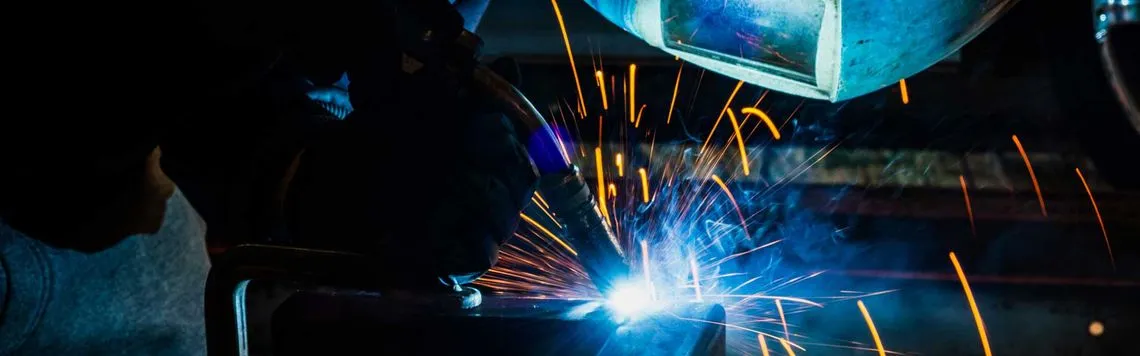
Every coded welding contract in Ireland eventually reaches the same checkpoint: show us the welder’s cert. This guide explains exactly what sits behind an EN ISO 9606-1 certificate — how the test works, what it qualifies the welder to do, and the six-month rule that quietly invalidates more certificates than any failed test ever has.
What EN ISO 9606-1 actually certifies
ISO 9606-1 is the international standard for qualification testing of welders — fusion welding of steels. It certifies a person’s ability to produce a sound weld by hand: the skill, not the recipe. (The recipe — the welding procedure — is qualified separately under ISO 15614-1, and the two are often confused. One proves the method works; the other proves this welder can execute it.)
A certificate records the essential variables the welder demonstrated: welding process, product type (plate or pipe), weld type, material group, filler, thickness range, pipe diameter, and welding position. Each variable carries a range of qualification — test once, weld anything inside the range.
The test, step by step
- Define the scope. The examining body agrees the process, joint, material and position that the production work requires — qualifying wider ranges where sensible so one test covers more work.
- Weld under examination. The candidate welds the test piece under the examiner’s supervision. There are no formal prerequisites beyond being physically capable of welding the joint in question.
- Mark and test. The completed test piece is indelibly marked and sent for examination at an approved laboratory — visual inspection first, then radiographic, ultrasonic or destructive testing (bend tests, fracture tests, macro-examination) depending on the joint and scheme.
- Certificate. Pass, and the certificate issues with its qualification ranges and the clock ticking on confirmations.
The whole cycle, done well, takes days rather than weeks — and multiple welders are commonly tested in a single session.
The six-month rule (read this twice)
Clause 9.2 of the standard outlines the ongoing validity of certificates at intervals of six months. Every six months, the person responsible for welding activities must confirm that the welder has worked within the original qualification range. No confirmation, no validity — regardless of how recently the welder tested.
It is an administrative act, not a re-test, but it must be documented. Our certification team sees more certificates invalidated by missed confirmations than by any technical failure. Put the six-month dates in the QA calendar the day the certificate arrives.
The three revalidation routes
Beyond confirmations, clause 9.3 offers three ways to keep a certificate alive long-term:
| Route | Mechanism | Best suited to |
|---|---|---|
| 9.3(a) | Re-test every 3 years | Small shops without documented production testing |
| 9.3(b) | Every 2 years: two production welds from the previous 6 months tested (RT, UT or destructive) with records kept — revalidates for a further 2 years | Fabricators whose production work is already tested |
| 9.3(c) | No end date, provided the welder works for the same manufacturer under a quality system verified to ISO 3834-2 or 3834-3, with documented weld quality | Serious fabricators with certified welding quality management |
Route (b) is the workhorse for most Irish fabricators: production NDT is happening anyway, so the evidence exists — it just needs to be kept and tied to the welder.
Why third-party certification is winning
Nothing in ISO 9606-1 forces an independent examiner — but contracts increasingly do. Main contractors, utilities and pressure equipment work want certificates issued by an accredited certification body, because in-house paperwork has an obvious conflict of interest.
Metlab certifies welders as an INAB-accredited certification body for persons (ISO/IEC 17024, Reg. No. 7007), with an impartiality committee safeguarding every certification decision. For pressure equipment, our status as a Recognised Third-Party Organisation under the Pressure Equipment Directive (2014/68/EU) means welder and procedure approvals for PED category II–IV work can be completed in Ireland without going abroad.
Practical advice from the examination floor
- Qualify ranges, not jobs. A slightly wider test piece often doubles the production range the certificate covers — plan the test around the year’s work, not this week’s.
- Diary the confirmations. Six-month confirmations and the two-year revalidation evidence are QA-system items; treat them like calibration dates.
- Test the way you weld. Position and process should match production reality — a PA (flat) qualification does not cover the positional pipe welds your site actually runs.
- Keep coupons honest. The test piece must be welded under examination conditions and marked immediately — clean chain of custody protects the welder as much as the client.
Need welders qualified — or certificates rescued before they lapse? Metlab runs qualification sessions at our facilities or on your site.
Frequently asked questions
How long does an EN ISO 9606-1 welder certificate last?
Indefinitely only on paper — in practice it survives through discipline. It must be confirmed every six months by the person responsible for welding activities, and revalidated by one of three routes in clause 9.3: a re-test every three years; revalidation every two years on the evidence of two production welds tested within the previous six months; or ongoing validity while the employer operates a verified ISO 3834-2 or 3834-3 quality system. Miss a confirmation and the certificate is invalid.
What does the welder qualification test involve?
The candidate welds a test piece under examination conditions in the process, material, thickness and position to be qualified. The test piece is indelibly marked and then examined — typically visual inspection plus radiographic, ultrasonic or destructive testing (bends, fractures, macros) at an approved laboratory — against the standard’s acceptance criteria.
Are there prerequisites to sitting a welder qualification test?
No formal prerequisites — the candidate simply needs to be physically capable of welding the joint in question. Training beforehand is sensible but not mandated by the standard.
Who can issue welder qualification certificates in Ireland?
Any examiner or examining body your contract accepts — but specifications increasingly require an accredited certification body. Metlab certifies welders under its INAB-accredited ISO/IEC 17024 scope (Reg. 7007), which is independent, third-party certification recognised across contracts and borders.